


Over the last 4 modules, we’ve explored how LabXchange content can support a lesson at each of its key moments—a hook to open, a resource to teach the core concept, practice to reinforce it, and support to meet every learner’s needs.
Now, let’s see what it looks like when LabXchange resources are used at multiple stages of a lesson to build a cohesive, connected learning experience for students.
Ms. Chen teaches Environmental Science and is planning a lesson on biodiversity and human impact. She would also like to incorporate data analysis skills into the lesson. After searching for “Biodiversity” in the LabXchange library, she finds a set of resources to build her lesson around. The learning objectives for the lesson are as follows.
By the end of the lesson, students will be able to:
Explain the 3 types of biodiversity (genetic, species, and habitat).
Identify the benefits ecosystems provide through biodiversity.
Examine human impact threats to biodiversity.
Investigate how data can help track the impact of human activity on biodiversity.
Ms. Chen wants a hook that puts the problem in context, draws on students’ prior knowledge of human impact, and primes them to start thinking about the role of data in biodiversity investigations. She finds a video on the greenhouse effect and clips just the opening 30 seconds for the class.
She facilitates a short class discussion using guiding questions to connect the clip to the lesson ahead:
Why do you think the CO2 cylinder heated up more than the one with regular air?
What everyday effect or process does this small experiment remind you of?
What would you need to do to test whether this same effect holds true at a much larger scale?
If there were a small living ecosystem inside those jars, what impact do you think the experiment would have on it?
She then plays the rest of the video, asking students to listen for evidence that supports or challenges their predictions and to notice what new terms or evidence the video introduces to explain why CO2 behaves this way.
The Biodiversity and Human Impact interactive Ms. Chen has built her lesson around comes with a customizable worksheet.
She makes a copy, removes Sections 1 and 5 (which she doesn't need for her lesson), and has students use Sections 2 and 3 as a note-taking resource while she introduces the content.
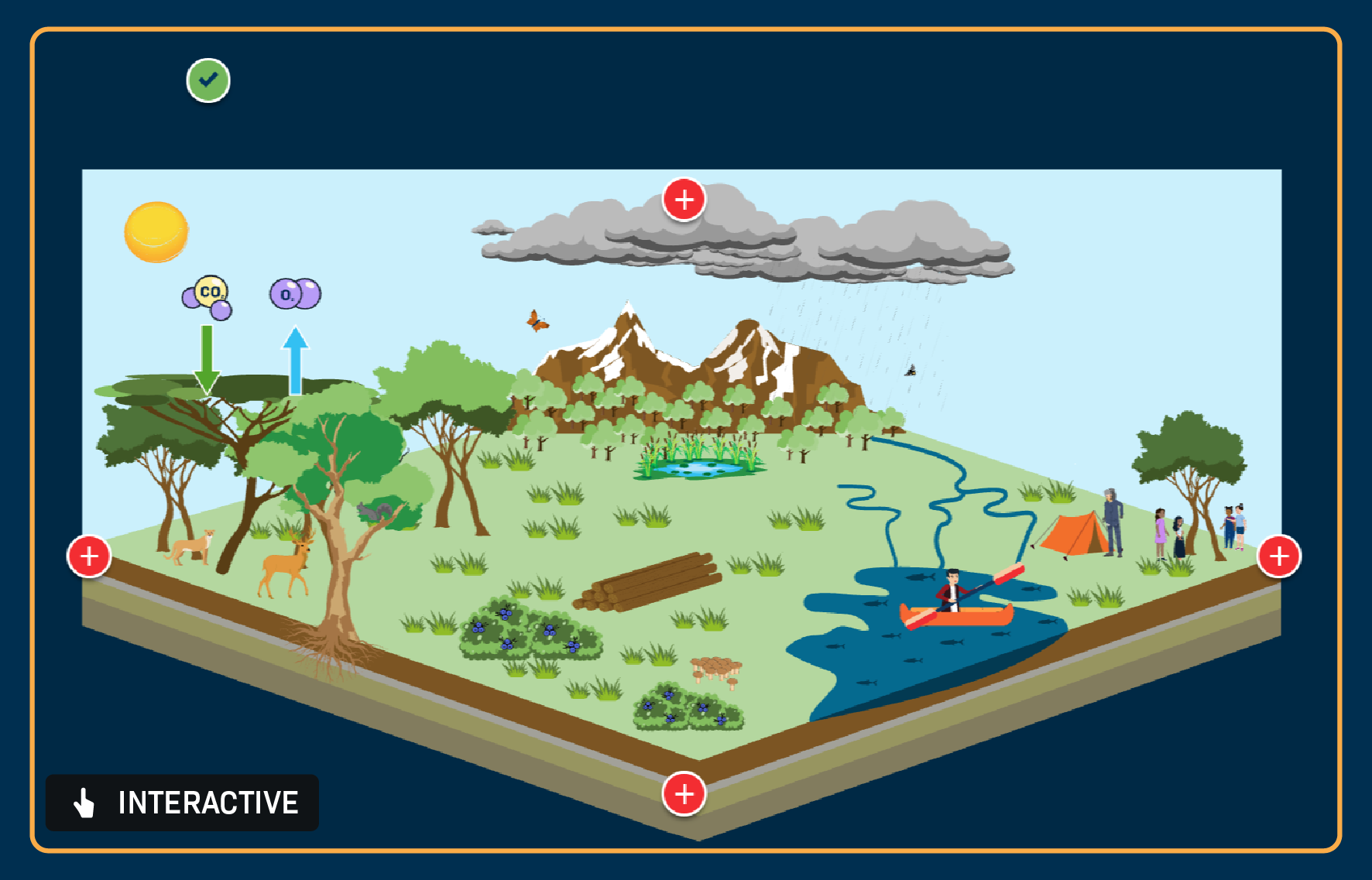
To introduce biodiversity and its 3 types, Ms. Chen clicks into the first branch of the Biodiversity and Human Impact interactive and displays it as a visual aid. Before revealing each type of biodiversity, she asks students to use the visual to guess what it might represent. She then works through examples for each type as a class.
.png)
From there, she moves to the flowchart in the same interactive to introduce why ecosystem biodiversity matters. Using the visual, she asks students to suggest some services an ecosystem might provide before introducing the 4 categories and working through examples of each. She closes the discussion with the interactive’s formative question, asking the class to vote on the answer based on what they’ve just covered.
Ms. Chen divides the class into small groups and directs them to the Anthropocene section of the interactive. She first has students click through the options to get a sense of the range of threats before each group selects 1 to explore in depth. They work through the case study and accompanying data, then discuss the reflection questions in the interactive.
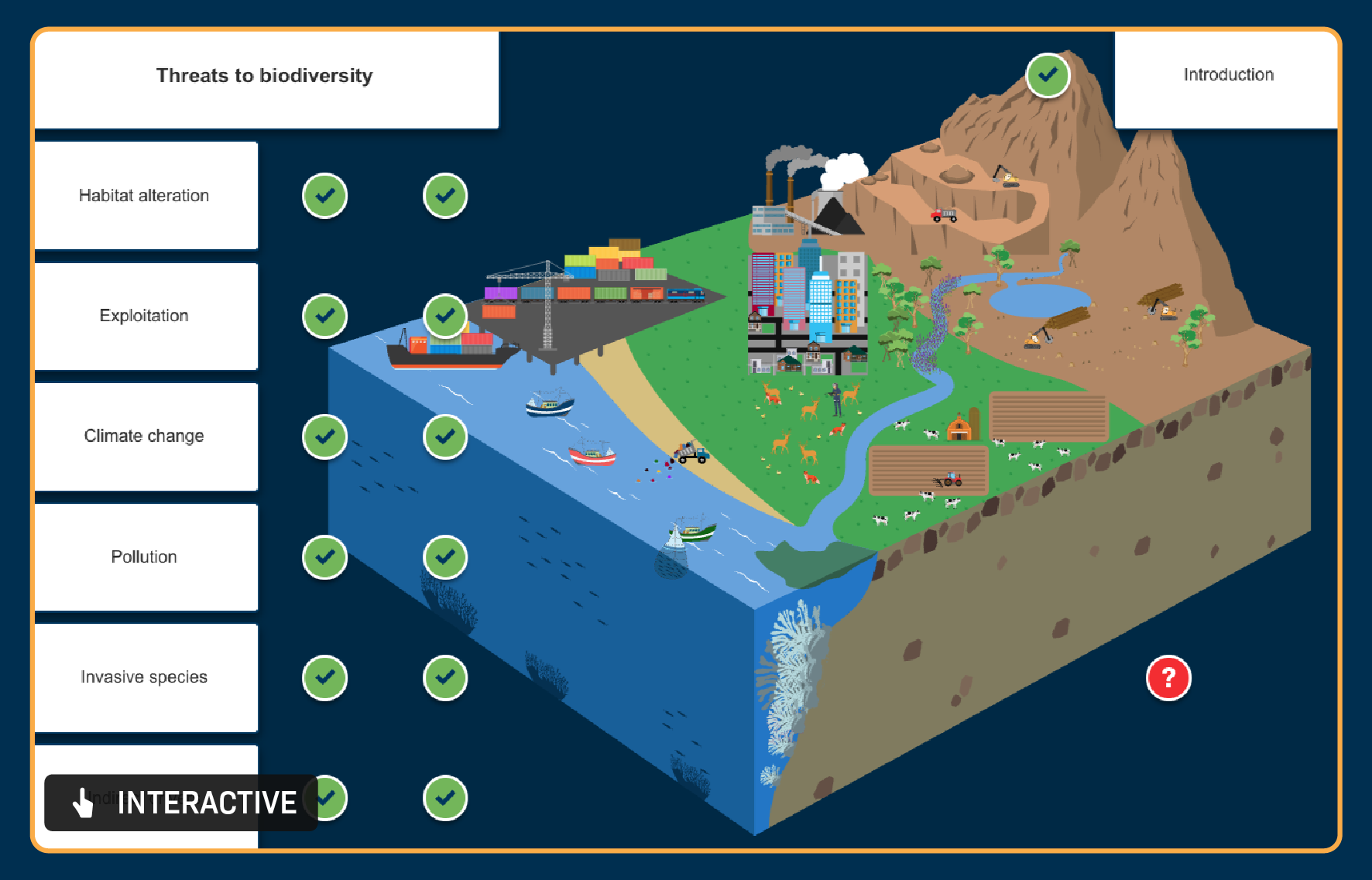
She writes the following guiding questions on the board for each group to discuss and respond to based on their chosen threat:
How might this threat impact the 3 types of biodiversity in the area (genetic, species, and habitat)?
What ecosystem services could be disrupted by this threat?
What conclusion are you able to draw about your threat based on the data provided?
Knowing that some students will need extra consolidation, Ms. Chen keeps the scaffolded Biodiversity in Practice pathway on hand. It combines text and video resources on the same topics and is ready to assign to students who need to revisit sections of material in a different format.
For students who finish early or want to go further, she offers text resource (Generating Research Questions and Hypotheses about Climate Change) as an optional extension. Students read the text, then design their own research question and hypothesis for studying a threat to biodiversity.
Ms. Chen assigns Section 4 of the worksheet so students can apply their understanding of biodiversity and human impact to a real-world context, while practicing genuine data skills: forming a hypothesis, collecting real data over time, and reasoning through what it shows. Students spend the following week collecting data at home, tracking their household's plastic waste day by day. Back in class, they work through the rest of Section 4 with Ms. Chen's support, then submit the completed section to her so she can evaluate their understanding
To close, Ms. Chen has students search the LabXchange library for biodiversity narratives and choose one to read. As an exit ticket, students write down an interesting thing they learned about biodiversity from the narrative.
For more examples of how to incorporate LabXchange resources into curriculum-aligned lessons, search for Teaching Guides in the LabXchange library.
Here are a few of our favorites to get you started:
Here’s a quick recap of the strategies covered in this course:
Opening a lesson with a visual resource or clip to spark students’ interests, activate prior knowledge, or build students’ confidence with a particular tool or procedure
Teaching a core concept or skill using a visual, simulation, or self-paced resource to help students understand new material
Practicing a concept or skill through varied activities and resources that help students revisit, apply, and solidify what they’ve learned
Meeting every learner by adapting and combining resources to stretch advanced students, support those who need it, and help every student see themselves in what they’re learning
Before you leave, take a moment to think about how the strategies covered in this course might fit into your own planning:
Think of a lesson you’re teaching soon. Is there a section or activity that could benefit from an additional resource, like a hook, a practice activity, or extra support for some students?
Which stage of a lesson—opening, core teaching, practice, or differentiation—do you currently find hardest to resource well? How might you use LabXchange to start building a bank of go-to activities for that stage?
What small change could you try in your next lesson based on what you’ve seen in this course?
.svg)

.svg)


